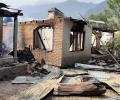
Hundreds of residents along the Line of Control (LoC) and the International Border (IB) in Jammu and Kashmir were evacuated to safer zones after Pakistani shelling following Indian airstrikes on terror targets in Pakistan. The shelling killed 12 people, including four children and two women, and injured over 50. The evacuations come amid heightened tensions between India and Pakistan following the April 22 terror attack in Pahalgam that left 26 civilians dead. The government has provided temporary shelter for those evacuated.

Several Pakistani nationals visiting India started returning home through the Attari-Wagah land route in Amritsar on Thursday, a day after the Centre set a 48-hour deadline for them to leave the country. The decision came after India announced a raft of measures, including the expulsion of Pakistani military attaches, suspension of the Indus Water Treaty of 1960, and the immediate shutting down of the Attari land-transit post in view of the cross-border links to the horrific terror attack in Kashmir's Pahalgam that killed 26 civilians on Tuesday.
The delayed timing of J&K Lieutenant Governor Manoj Sinha's admission has more to do with deflecting the thrust of the Opposition attack on the prime minister and Union home minister during the monsoon session of Parliament, points out Mohammad Sayeed Malik, the distinguished commentator on Kashmir affairs.
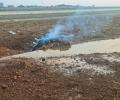
Dar's statement, echoed by another federal minister, came as the Indian and Pakistani militaries targeted each other's installations using missiles in the last more than 12 hours, further escalating the already tense conflict situation.

Ahead of the Asia Cup, former Indian cricketer Surinder Khanna shared his views on whether the India-Pakistan clash should be played

India on Thursday night swiftly foiled Pakistan's attempts to hit various key Indian installations including military stations at Jammu, Pathankot and Udhampur with drones and missiles, the defence ministry said.
'The Pakistanis knew there was only one route up and they could take direct aim at us as we climbed up.' 'They knew they could kill us.'
'We do not want to fall into a trap of uncontrolled escalation or all out conflict.' 'When the need arises we will do that.'
Pakistani troops continued unprovoked small arms firing in different sectors along the Line of Control (LoC) in Jammu and Kashmir for the 10th consecutive night, prompting effective retaliation by the Indian army. The ceasefire violations, which started after the April 22 terror attack in Pahalgam, were reported from eight places across five districts in the Union Territory during the intervening night of Saturday and Sunday. Indian Army responded promptly and proportionately to the unprovoked firing, a defence spokesperson said.

The Federation of Western India Cine Employees (FWICE) urged Prime Minister Narendra Modi to stop the telecast of Sunday's India vs Pakistan Asia Cup match in Dubai.
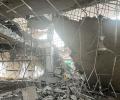
Indian Air Force S-400 Sudarshan Chakra air defence missile systems were fired last night against targets moving towards India. The targets were successfully neutralised in the operation multiple domain experts told ANI.

The Indian Air Force conducted precision strikes on terror hideouts in Pakistan, targeting a Jaish-e-Mohammad communication network housed in a primary health centre in Tehra Kalan village. The communication setup was essential for planning and coordinating activities with infiltrated terrorists in Jammu and Kashmir. The strikes aim to dismantle the communication network and hinder the terrorists' ability to operate.

The post further read that "at a moment of heightened regional turbulence", President Trump "demonstrated great strategic foresight and stellar statesmanship through robust diplomatic engagement with both Islamabad and New Delhi," Dawn reported.

The Border Security Force (BSF) remains on high alert along the International Border (IB) and has not let its guard down, BSF Inspector General, Jammu Frontier, Shashank Anand said on Tuesday. Operation Sindoor, aimed at preventing infiltration attempts, continues as Pakistan cannot be trusted, he added. Anand highlighted the BSF's robust response after the April 22 Pahalgam terror attack, including destroying multiple terror launch pads and thwarting infiltration attempts.
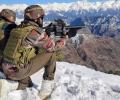
Pakistan's troops have engaged in unprovoked firing along the Line of Control (LoC) and International Border (IB) in five districts of Jammu and Kashmir, prompting retaliation from the Indian Army. This marks the eighth consecutive night of such incidents, following heightened tensions stemming from a recent terror attack in Pahalgam. Civilians residing along the LoC and IB are preparing their bunkers in anticipation of potential escalation.
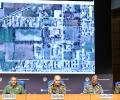
'We completely destroyed at least three posts, an ammunition depot, fuel storage facility, and gunnery, among other targets. Our retaliation was so devastating that it will take Pakistan at least 8-12 months to rebuild, possibly longer'

So, when to start, when to stop, how much to apply in terms of time, space and resources, and how much, what is the definition of calibrated action, all these things were something "we kept discussing at every time," Gen Dwivedi recalled.

Sonam Wangchuk is under tight surveillance within the three-tiered prison, with CCTV cameras monitored around the clock.

A police officer and his eight siblings, including five sisters, were deported to Pakistan on Wednesday despite a court order granting them temporary relief. The nine members of the extended family, who have been living in Jammu and Kashmir for generations, were among more than two dozen people, mostly from Pakistan-occupied Kashmir (PoK), who were served deportation notices following the April 22 Pahalgam terror attack. The deportation has sparked outrage, with protests and appeals for intervention from the home minister and lieutenant governor. The family members claim they are not Pakistani nationals and have been living in the region for generations, presenting revenue records to support their claims. The court has ordered a detailed report on the case within two weeks and will hear it again on May 20.
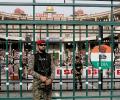
The intruder, who is in his early 20s, was taken into custody by Army troops soon after he entered into this side from across the LoC.

The Chinese see no need to fight directly. They have an able and willing proxy in Pakistan, points out Shekhar Gupta.

'There's a lot of sense in what Prime Minister Modi did, but the Indian government has to be really prepared for a really sharp escalation spiral.'
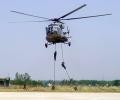
'Pakistan cannot sustain a war with India for more than four days. They are in such dire straits. At best they can sustain war for one week.'
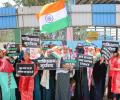
The Indian government has blocked 16 Pakistani YouTube channels for allegedly disseminating provocative and communally sensitive content as well as false and misleading narratives against India, its Army and security agencies. The decision was taken following recommendations from the Ministry of Home Affairs in the wake of the April 22 terror attack at Jammu and Kashmir's Pahalgam in which 26 people, mostly tourists, were killed.
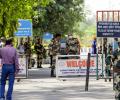
Abdul Waheed was brought from Srinagar by the Jammu and Kashmir police for his repatriation to Pakistan.
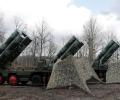
India successfully intercepted or neutralized all Pakistani missiles and drones that targeted 15 Indian cities on Wednesday night, according to official sources. The attack, which was launched in response to India's Operation Sindoor, involved the deployment of Barak-8 missiles, S-400 Triumph air defense systems, Akash surface-to-air missiles, and indigenously developed anti-drone equipment. India retaliated with precision strikes on Pakistani territory, destroying an HQ-9 air defense unit in Lahore and damaging key radar infrastructure. The incident highlights the strength of India's air defense capabilities and its ability to project power with surgical precision.

The tragedy struck the family on May 7 when they found themselves in the middle of intense Pakistani shelling at their rented accommodation in Poonch which was badly hit by the cross-border shelling.

Heavy Pakistani shelling in the border district of Poonch in Jammu and Kashmir left nine people dead and 28 injured. The shelling, described by residents and officials as "barbaric and cowardly", started around 2 am, damaging dozens of residential houses, shops, vehicles, and heritage sites. The incident comes after India launched "Operation Sindoor" in retaliation to the April 22 Pahalgam terror attack. India condemned the act, calling it a cowardly attack on civilians, and reaffirmed that civilian safety remains its top priority.

The Pakistan Army continued shelling along the Line of Control (LoC) in four sectors of Jammu and Kashmir, prompting a befitting response by the Indian Army, officials said on Thursday. The intensity of cross-border firing was less than Wednesday, when Pakistan Army carried out one of the most intense artillery and mortar shelling in years targeting the forward villages in J-K following missile strikes by India as part of 'Operation Sindoor'.

Saikia stressed that the Indian cricket board will continue to adhere to the policy formalised by the government.

The Indian Army responded in a measured and effective manner to the provocation.

Shiv Sena (UBT) MLA Aaditya Thackeray on Friday slammed the Board of Control for Cricket in India (BCCI) over the India and Pakistan clash in the ongoing Asia Cup 2025.

Even Prime Minister Narendra Modi told US Vice President JD Vance on May 9 that Indian response will be "more forceful, stronger, devastating" in response to Pakistani actions, the sources said.

Shehbaz made the comments during a visit to the Kamra air base in the country's Punjab province where he interacted with officers and soldiers involved in the recent military confrontation with India.
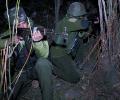
For the ninth consecutive night, Indian and Pakistani troops engaged in small arms fire along the Line of Control (LoC) in Jammu and Kashmir, continuing a pattern of heightened border tensions. The skirmishes, initiated by Pakistani troops in violation of the ceasefire agreement, have led to a tense situation along the LoC and International Border (IB). The incidents come in the wake of the April 22 terror attack in Pahalgam, which claimed the lives of 26 people, mostly tourists. Civilians residing near the border have begun preparing their bunkers, anticipating potential escalation. Despite a recent hotline conversation between the Directors General of Military Operations (DGMOs) of India and Pakistan, where India cautioned Pakistan, the ceasefire violations persist.
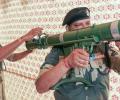
The Border Security Force (BSF) is raising a maiden 'drone squadron' for deployment along the India-Pakistan border. The squadron will comprise reconnaissance, surveillance and attack drones and specially-trained personnel.
US Secretary of State Marco Rubio on Thursday spoke separately with External Affairs Minister S Jaishankar and Pakistani Prime Minister Muhammad Shehbaz Sharif, emphasising the need for de-escalation and reiterated his calls for Pakistan to take concrete steps to end any support for terrorist groups.

India on Sunday said it inflicted tremendous losses to the Pakistan military, including downing its fighter jets featuring latest technologies and damaging key military installations close to even capital Islamabad, during the three-day confrontation between the two sides.
'Pakistan had almost disappeared from Kashmir.' 'Now in the last three, four years we have brought Pakistan back again by not handling Kashmir properly.'

India has accused Pakistan of violating the spirit of the Indus Waters Treaty by engaging in acts of terrorism and refusing to modify the treaty. India's Permanent Representative to the UN, Ambassador Parvathaneni Harish, addressed the UN Security Council, highlighting Pakistan's disinformation regarding the treaty and its continued support for cross-border terrorism. He stated that India has always acted responsibly as an upper riparian state and that Pakistan's actions have jeopardized civilian lives, religious harmony, and economic prosperity. India has suspended the treaty until Pakistan ends its support for terrorism.
